
Christmas Advent Blog – The Birmingham Pedajolly on the Pedagogy Fun Train
Last week I went on a Pedajolly to Birmingham to the Nursery World Conference with two colleagues. Ben who leads the LEYF Training Academy and Jean who manages a…
September 1st 2026
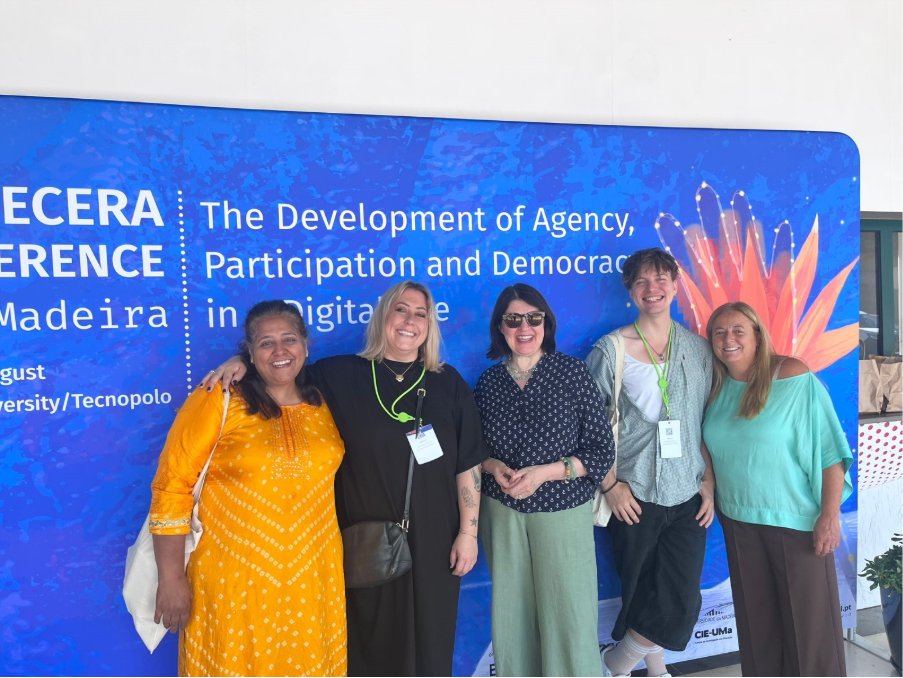
Even in a digital age, nobody goes to a good conference without a notebook. I spent three days at the 34th EECERA Conference at the University of Madeira with four LEYF colleagues, scribbling notes, photographing slides and having rich pedagogical conversations.
People sometimes look slightly glazed when you say you are going to an academic conference. I love them because a good conference makes my head hurt. EECERA certainly did.
The theme was The Development of Agency, Participation and Democracy in the Digital Age. What connected the many discussions for me was pedagogy. Professor Julia Formosinho reminded us that democracy in Early Childhood is learned through daily pedagogical experience.
This is not about teaching three year olds how to vote. Democracy becomes real when children experience having a voice, asking questions, making choices, negotiating with others and influencing what happens around them.
Children and teachers are on a joint journey where curiosity, dialogue and participation matter. Her references to some of my favourite influences on the LEYF Pedagogy for Social Justice, Pestalozzi, Froebel, Dewey, Freire and Malaguzzi, reinforced something fundamental.
Pedagogy brings together theory, practice, research and ethics. It determines how children experience what we say we believe.
One of the pleasures of a research conference is hearing people take pedagogy seriously. Early Years teaching is an art, craft and science. It requires knowledge of child development, theory, relationships, curriculum and observation, alongside the ability to interpret what is happening in front of you and respond intelligently.
This is particularly important for new teachers and educators. We need to prepare them to think, question and make informed pedagogical judgements, not simply demonstrate competence against a checklist. Standards and regulation matter, but compliance cannot substitute for pedagogy.
This became particularly interesting when Professor Susie Edwards from Australian Catholic University challenged some of my assumptions about digital technology. Like many Early Years people, I have been wary about bringing more technology into nurseries because children already experience plenty of screens. But perhaps screens are the wrong starting point. Children are growing up in a digital world.
Our responsibility is to consider how pedagogy helps them develop the language, agency and judgement to participate in it.

We also need to distinguish digital technology from AI. Digital literacy helps children begin to understand devices, information, communication, networks and personal data. AI introduces something different because increasingly the technology can use data to generate, recommend, predict and influence. I heard about AI enabled fridges that can identify what you need, order food and suggest recipes.
Apparently, this is helpful. Personally, I am not convinced I want my fridge adding itself to the list of things telling me what I ought to be doing. But beneath the gadgetry sits a serious pedagogical question.
What knowledge, dispositions and critical capabilities will children need to live well in a world increasingly shaped by AI?
Once again, play may provide part of the answer. Edwards described wooden mobile phones, routers and Wi-Fi connectors appearing in role play. Not because three year olds need to configure the broadband, but because they create conversations. Did you ask before you shared that? Who does that information belong to? Can she say no? Who gets to decide?
Professor Andrew Manches from the University of Edinburgh link extended this thinking through personal data literacy. He also brought Charlie Brooker’s Black Mirror episode Arkangel into the conversation. If you haven’t watched it, do. A mother’s determination to protect her daughter through technology reaches a disturbing conclusion. Protection without agency can slide into surveillance and control. That is worth pondering in Early Years, where our entirely legitimate concern with safeguarding can encourage us to see digital technology principally through the lens of risk.
Perhaps digital literacy can begin much more simply. Mine or yours? Private or public? Did you ask? Can I say no? Who are you sharing this with? Teachers do not need to arrive as digital experts with all the answers. Teachers and children can investigate these questions together through play. That is pedagogical partnership, and it takes us straight back to democracy. Children learn that they have rights, that other people have rights, that choices have consequences and that they are entitled to question decisions affecting them.
The same question was raised in the EECERA Sustainability SIG, which I have been part of for several years. We know how becoming sustainability-informed cannot be achieved by simply giving teachers more information about climate change. Knowledge matters, but so do the confidence to question it, the ability to have difficult conversations and the agency to act. Digital literacy and AI literacy present a similar pedagogical challenge. We need teachers who can engage critically with change rather than simply receive the next set of instructions about what they should teach.
This creates a challenge for leadership. We cannot simply bolt digital or AI literacy onto an already crowded curriculum. Teachers need credible knowledge, opportunities to discuss and question it, coaching to experiment with new ideas and communities where learning develops. This takes me back to my ACT model, Anchor, Change, Transform. My research identified four conditions that help professional learning become anchored: Credible Cognition, Compassionate Conversations, Compassionate Coaching and Communities of Practice. 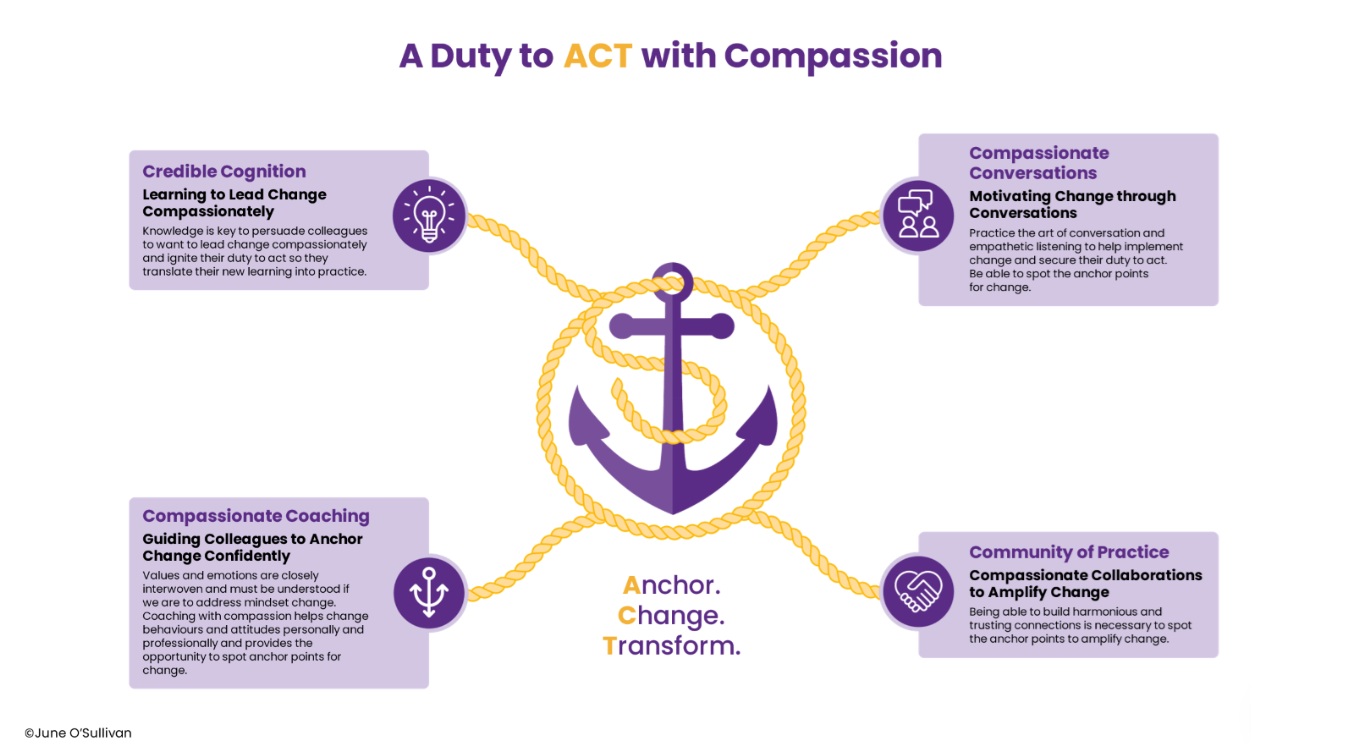
EECERA reminded me why this matters. Whether we are considering AI, digital participation, children’s agency or educator development, the challenge is similar. How do we get from knowing something to doing something differently? That is not simply a professional development question. It is a social justice question because a child experiences what we do differently because of what we have learned.
So I came home from EECERA with a different question. Digital technology will continue to change childhood and AI will accelerate some of that change. The issue is not whether Early Years should embrace or resist it. It is whether we understand our pedagogical position well enough to help children become informed, questioning and active participants in shaping the world they inhabit.
That seems to me a rather important democratic responsibility. And perhaps the test of the conference is the simplest question of all. What will I do differently now?
1. What is digital literacy in Early Years?
Digital literacy in Early Years is about helping children develop the knowledge, language and judgement to understand and participate in an increasingly digital world. It is not simply about using screens or teaching children how to operate devices. Through play, conversation and everyday experiences, children can begin to explore ideas such as privacy, choice, communication, information and personal data.
2. How can Early Years settings support digital literacy without increasing screen time?
Early Years settings can develop digital literacy through play, discussion and real-world experiences, without relying on additional screen time. Role play, stories and conversations can help children explore questions such as who information belongs to, whether someone has given permission and whether they can say no. The focus should be on pedagogy and children’s agency rather than simply introducing more technology.
3. What is the role of AI in Early Years education?
AI is different from traditional digital technology because it can use data to generate, recommend, predict and influence. Early Years education therefore has an important role in helping children develop the critical thinking, agency and judgement they will need to live in a world increasingly shaped by AI. This does not mean teaching young children how to use AI, but developing the foundations for questioning and understanding technology.
4. Why is pedagogy important when teaching digital literacy in Early Years?
Pedagogy determines how children experience learning and how educators respond to their questions, interests and ideas. Digital literacy should therefore be approached through strong Early Years pedagogy, where children can develop agency, ask questions, make choices and learn through relationships and play. Technology should support these experiences rather than replace them.
5. How can play help children develop digital and AI literacy?
Play gives children opportunities to explore digital concepts in meaningful, age-appropriate ways. For example, role play involving phones, Wi-Fi routers or other technology can prompt conversations about communication, privacy, sharing information and consent. These experiences help children develop the language and confidence to question how technology works and how it affects their lives.
Last week I went on a Pedajolly to Birmingham to the Nursery World Conference with two colleagues. Ben who leads the LEYF Training Academy and Jean who manages a…

Continuing with the Christmas Advent tradition, on day eleven of Christmas Advent 2019 let’s reflect on what the pedagogy looks like in practice? Read my recent post reflecting on pedagogy…
Context: Why ESG Is Rising Up the Agenda I joined an audience of charities and investors at the ESG Imperative Conference, organised by…